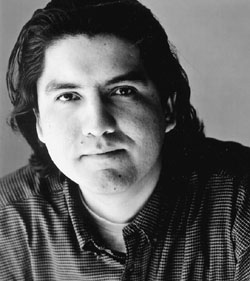
“This might be an interesting story all by itself. A little Indian boy teaches himself to read at an early age and advances quickly. He reads "Grapes of Wrath" in kindergarten when other children are struggling through "Dick and Jane." If he'd been anything but an Indian boy living on the reservation, he might have been called a prodigy. But he is an Indian boy living on the reservation and is simply an oddity. He grows into a man who often speaks of his childhood in the third-person, as if it will somehow dull the pain and make him sound more modest about his talents.” (Selection from Sherman Alexie's "Superman and Me")
Although this is not a concise passage to examine it does offer some fantastic play with point of view and meta-commentary to create an effect that confronts the reader on many fronts. Until this passage Alexie has dealt with the narrative from a more traditional stance, providing the story from the first person of one who is recollecting, confronting the images from memories and doubts that come with memory recall. Writing from the first person point of view lets the reader come close to the author and invite the reader into a world of possibilities, full of room for discussion and human discourse; mainly, first person offers an understanding of the author as a person to relate to. However, changing the point of view to the third person creates instant space in our understanding of the author as a person to relate to. Third person narratives shove aside closeness in favor of the power of assertion. When Alexie shifts to third person it seems he is telling us not about his story but an imagined story where the value of the story is not in the relationship between the reader and author but in the authority of the author over the reader.
In my own writing I often seek ways to manipulate the space and closeness the reader feels between himself/herself and my voice. I often find myself, stuck at a point in some narrative, where I want to deploy a dramatic effect: create distance, close distance and use the notion of space between reader and author to my advantage. Practicing the technique of a well-placed shift in point of view would add another useful tool into my author utility-belt.


No comments:
Post a Comment